

In a recent blog we reflected on key presentations at the ERS relating to pulmonary fibrosis, including the promise shown by the orally-delivered preferential PDE4B inhibitor, nerandomilast, now approved by the FDA for the treatment of IPF. However, the Fibroneer programme with nerandomilast further served to emphasise the challenge faced when attempting to use new oral therapies as add-on to Standard of Care (SoC: in IPF, pirfenidone or nintedanib). Severe DDIs were seen with pirfenidone and additive GI side effects (particularly diarrhoea) were observed when nerandomilast was added to nintedanib.
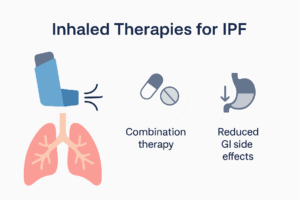
The challenge of additive GI side effects when combining new oral agents with SoC in IPF has been long recognised and has led to the demise of a number of mechanistically promising new approaches. We have reviewed this in some detail and proposed a new paradigm, in which the additive GI side effects are avoided by delivering one (or both) components by inhalation. With this in mind, it was encouraging to also see at the ERS meeting progress in the development of a number of inhaled approaches for treatment of IPF.
Encouraging Progress
In the Teton-2 Phase 3 study in 597 IPF patients, nebulised Treprostinil (Tyvaso) met its primary efficacy endpoint of improvement in absolute forced vital capacity (FVC) relative to placebo after 52 weeks of treatment. Benefits of Tyvaso were observed regardless of whether background anti-fibrotic therapy was nintedanib, pirfenidone, or neither. Most secondary endpoints were also achieved, including a statistically significant improvement in quality of life.
There was also a presentation of the study design for AURA-IPF, a planned Phase 2 clinical trial of AP02 (inhaled nintedanib) for the treatment of IPF. If development of AP02 is successful, we can imagine a future where the full potential of novel therapies, such as nerandomilast, can be realised, enabled by the benefits of combining with inhaled (rather than oral) delivery of SoC.
Preclinical data were also presented on LTI-03, a peptide derived from the scaffolding domain of Caveolin 1. LTI-03 produced a dose dependent increase in epithelial cell survival in precision cut lung slices biopsied from both non-specific interstitial pneumonia and end-stage IPF patients. A Phase 2 study (RENEW) of LTI-03 in IPF patients has recently received European regulatory approval. The effect of LTI-03, administered via dry powder inhaler, on lung function (FVC) decline and lung fibrosis (high resolution computed tomography) will be compared with that of placebo following 24 weeks treatment.
The Road Ahead
Together, these examples highlight growing confidence in inhaled delivery as a strategy to enhance efficacy while mitigating systemic toxicity. It is exciting to see inhaled approaches moving forward in clinical development in IPF.
If you would like to explore how inhalation therapies could reshape the treatment landscape for IPF and other respiratory conditions, TherapeutAix is ready to help. Our team of experts is dedicated to guiding biopharmaceutical companies in developing innovative drug delivery strategies in respiratory and beyond. Contact us today to discuss your project needs.